A Classic
Mahler's Origins: A "Sonic Goulash"
Church
Music shaped by the sacred tradition reflects Mahler’s ongoing search for spiritual transcendence through art.
“O believe, my heart, O believe”
Mahler's Methods
Hallelujah
Shared Experiences
August 15, 2012
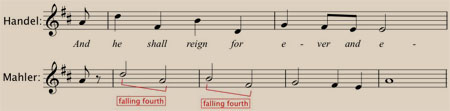
The direct source for the end of Mahler’s 1st Symphony is not Handel’s Hallelujah Chorus. Actually, it pinches the striking core theme of Rott's Suite in E [1878]. The intervals and rhythms are the same for Rott's 7-note theme and Mahler's signal triumph of victory standing horns bells peel chorale motif. All Mahler did with it at the end of the finale of his Symphonic Poem at Budapest 1889 (as played again in September 2011 by Hugh Wolff/New England Conservatory Philharmonia using the Mahler-Rosé Collection manuscript) was to add a note to the start, and Mahler kept this ending through the Hamburg 1893 version and onwards into his First Symphony as we now know it today.
Mahler’s frequent use of Hans Rott’s symphony [1880] is well known (especially in Symphonies 1-5) but this shows he borrowed from two of Rott’s works in this same movement (1:4), although of course it is possible Rott himself was drawing on Handel. The Suite was heard by Mahler more than a decade before his Budapest proto-premiere, when the suite and one of Mahler’s works were both played by orchestra at a Vienna Conservatory examination performance on 27 May 1878. It has only been heard since a few times live (most recently under Herreweghe in 2011, see the Hans Rott site http://bit.ly/TFkg5X) and on the now out of print CD issued of the Suite: Hermus/Philharmonische Orchestra/Accousence ACO-CD 20305 (although I can supply MTT or SFSO with the mp3). The detailed analysis was published in 2005 – see http://bit.ly/O3wlCz
MTT has led the performance of the Rott Symphony's Scherzo. It would be great if he conducted the whole symphony (slow like Segerstam, to draw out the dramatic narrative, rather than fast and cleaned up like Paavo Järvi's latest recording), and performed the US premiere of the Suite in E, and acknowledged the heavy use of Rott quotes by Mahler, for whom this obviously had special significance.
paul barasi in london
pbarasi54@btinternet.com
Post new comment